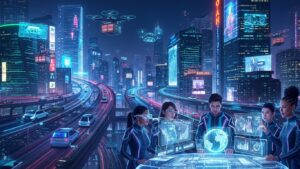
The Future of Technology: How Innovation is Shaping Our World

Technology has become the cornerstone of modern society, influencing every aspect of human life. From the way we communicate to the manner in which industries operate, technology continues to transform our world at an unprecedented pace. As we stand on the brink of a new era of innovation, it is essential to understand the trends, opportunities, and challenges that come with technological advancement.
The Rise of Artificial Intelligence
Artificial Intelligence (AI) is no longer a futuristic concept; it is a present-day reality shaping industries and lifestyles. AI algorithms are embedded in everyday applications, from voice assistants that understand natural language to recommendation engines that personalize our digital experiences. Businesses are leveraging AI to enhance decision-making, automate repetitive tasks, and provide predictive insights that were previously unimaginable.
The potential of AI extends beyond efficiency. In healthcare, AI-driven diagnostics can detect diseases at an early stage, potentially saving millions of lives. In transportation, autonomous vehicles are on the horizon, promising to reduce human error and make travel safer. However, as AI continues to evolve, ethical considerations, data privacy, and job displacement become critical concerns that must be addressed.
The Expansion of the Internet of Things
The Internet of Things (IoT) has transformed ordinary devices into smart, interconnected systems. From home automation to industrial monitoring, IoT enables seamless communication between devices, allowing for real-time data collection and actionable insights. Smart homes equipped with IoT devices can control lighting, temperature, and security systems remotely, enhancing convenience and energy efficiency.
Industries are also benefiting from IoT on a massive scale. Manufacturing plants utilize IoT sensors to monitor equipment health, predict maintenance needs, and optimize production schedules. Agriculture has seen a revolution with IoT-enabled devices tracking soil health, weather patterns, and crop growth, leading to increased yield and sustainable farming practices. Despite its advantages, IoT also raises concerns about cybersecurity, as more connected devices can increase vulnerabilities to cyberattacks.
The Emergence of Quantum Computing
Quantum computing represents a leap forward in computational power, promising to solve problems that are currently impossible for classical computers. Unlike traditional computers that use bits to process information, quantum computers use qubits, which can exist in multiple states simultaneously. This property allows quantum computers to perform complex calculations at speeds exponentially faster than conventional machines.
Industries such as pharmaceuticals, finance, and logistics are expected to benefit significantly from quantum computing. Drug discovery can be accelerated by simulating molecular interactions at an unprecedented scale, while financial institutions can optimize trading strategies and risk management with enhanced computational capabilities. Despite its potential, quantum computing remains in its infancy, with challenges such as qubit stability and error correction yet to be fully overcome.
The Evolution of 5G Connectivity
The rollout of 5G networks is set to redefine connectivity, offering ultra-fast internet speeds, low latency, and the ability to connect a vast number of devices simultaneously. This next-generation wireless technology is not just about faster downloads; it is about enabling new applications that were previously impossible.
Smart cities are one area that stands to gain immensely from 5G. With faster, reliable connectivity, urban infrastructure can be optimized for traffic management, energy consumption, and public safety. In entertainment, 5G will enable high-definition streaming, augmented reality experiences, and immersive gaming without lag. As 5G continues to expand, addressing infrastructure challenges and equitable access remains a key focus for policymakers and technology developers alike.
The Role of Blockchain Beyond Cryptocurrency
Blockchain technology gained initial fame through cryptocurrencies, but its potential extends far beyond digital currency. By creating decentralized and tamper-proof digital ledgers, blockchain offers a new paradigm for trust and transparency in various sectors.
In supply chain management, blockchain can track products from origin to consumer, ensuring authenticity and reducing fraud. In healthcare, patient records can be securely shared between institutions while maintaining privacy. Even in voting systems, blockchain has the potential to provide transparent and tamper-proof election processes. The challenge for blockchain lies in scalability and regulatory acceptance, but its transformative potential is undeniable.
The Impact of Automation and Robotics
Automation and robotics are redefining labor markets and industrial processes. Advanced robotics can perform repetitive tasks with precision, increasing efficiency and reducing errors. Industries such as manufacturing, logistics, and agriculture are adopting robotic systems to streamline operations, reduce costs, and improve productivity.
Collaborative robots, or cobots, are designed to work alongside humans, enhancing capabilities without replacing human labor entirely. While automation brings efficiency, it also sparks debates about workforce displacement, the need for reskilling, and the creation of new job categories. Balancing technological progress with social responsibility is essential for a sustainable future.
Cybersecurity in a Digital Age
As technology advances, cybersecurity becomes an increasingly critical concern. With the rise of interconnected devices, cloud computing, and digital services, the potential attack surface for cybercriminals has grown exponentially. Data breaches, ransomware attacks, and identity theft are now common threats that affect individuals, businesses, and governments alike.
Proactive cybersecurity measures are essential to protect sensitive information and maintain trust in digital systems. This includes adopting advanced threat detection systems, encryption technologies, and comprehensive security protocols. Equally important is fostering cybersecurity awareness among users, as human error remains one of the leading causes of security vulnerabilities.
Sustainable Technology and Green Innovation
Technology also plays a vital role in addressing environmental challenges. Sustainable technology focuses on reducing carbon footprints, optimizing resource usage, and promoting renewable energy adoption. Innovations in energy storage, solar and wind technologies, and electric vehicles are reshaping the way we think about energy consumption.
Smart grids, powered by digital technologies, enable efficient distribution and management of energy, reducing waste and supporting the integration of renewable sources. Additionally, green computing initiatives focus on designing energy-efficient data centers and devices, minimizing environmental impact while sustaining technological growth. As the world faces climate change challenges, sustainable technology becomes not just desirable but imperative.
The Convergence of Technologies
One of the most exciting aspects of the current technological landscape is the convergence of multiple innovations. Artificial intelligence, IoT, 5G, blockchain, and quantum computing are not isolated; they intersect to create new opportunities and possibilities. For instance, AI-powered IoT devices with 5G connectivity can enable real-time decision-making in smart cities, while blockchain can ensure data integrity across these systems.
This convergence fosters innovation in areas such as healthcare, finance, transportation, and education. The ability to combine technologies allows for solutions that are more efficient, scalable, and impactful. Understanding these intersections is key for businesses, policymakers, and individuals who wish to stay ahead in a rapidly evolving technological ecosystem.
Challenges and Ethical Considerations
While technology brings numerous benefits, it also poses significant ethical and societal challenges. Issues related to data privacy, AI bias, automation-driven unemployment, and digital inequality must be addressed responsibly. Ethical technology development requires transparency, accountability, and inclusivity, ensuring that advancements benefit society as a whole rather than creating new disparities.
Policymakers, technologists, and the public must engage in ongoing dialogue to create frameworks that balance innovation with ethical considerations. Regulatory approaches must evolve alongside technological advancements to mitigate risks without stifling creativity or progress.
Conclusion: Embracing the Technological Future
The future of technology is both exciting and complex. It holds the potential to revolutionize industries, enhance human capabilities, and address some of the world’s most pressing challenges. From artificial intelligence and quantum computing to sustainable innovation and advanced connectivity, the possibilities are limitless.
However, the journey forward requires careful consideration of ethical, social, and environmental implications. Embracing technology responsibly ensures that its benefits are maximized while minimizing potential risks. As innovation continues to accelerate, society stands at the threshold of a transformative era, where imagination, creativity, and responsible action will define the world of tomorrow.